Your Dog's Treat Label Is Lying to You (And Here’s How to Read It Like a Pro)
You’re standing in the pet store aisle, bag of dog treats in hand, squinting at the ingredient list. There’s something called “poultry by-product meal,” then “corn gluten meal,” then a parade of words that sound more like a chemistry exam than food. You put it back. You pick up the next one. Same story, different order.
Here’s the thing: knowing how to read pet treat ingredient labels is one of the most genuinely useful skills you can have as a pet parent. It takes about two minutes to learn, and it changes how you shop forever. Let’s break it down.
Start With the Ingredient List (Not the Front of the Bag)
Flip the bag over. Ignore the happy dog on the front and the words “natural” and “wholesome” splashed across the packaging. Those words are marketing. The ingredient list is the truth.
By law, AAFCO requires that ingredients be listed in descending order by weight — so the first ingredient is the one your pet is eating the most of. If the first ingredient is “chicken” but the third, fourth, and fifth are all variations of corn (corn flour, corn starch, corn syrup), your dog is eating way more corn than chicken. That’s not a chicken treat. That’s a corn treat with chicken flavor.
The AKC advises focusing on the first three to four ingredients — they make up the majority of the product. If those ingredients are whole proteins or recognizable foods, you’re in decent shape. If they’re a jumble of by-products and fillers, keep walking.
Red Flags: What to Actually Avoid in Dog Treats
Ingredient Splitting
This is the sneakiest trick in the pet food playbook. Manufacturers know that ingredients must be listed by weight — so if they used enough sugar to make it the #2 ingredient, they’d have to list it second. Instead, they split it into “corn syrup,” “cane molasses,” and “dextrose.” Three different names, one problem. Individually, each one falls lower on the list. Collectively, they’re still a lot of sugar.
Watch for this with grains too — you might see “brown rice,” “rice bran,” and “rice flour” all on the same label. That’s three forms of rice masquerading as three different ingredients.
Vague Protein Sources
“Meat and bone meal” and “poultry by-product meal” are not the same as “chicken” or “beef.” The FDA has specific standards for what can go into animal feed — and some of what’s technically permitted in feed-grade products would stop most people cold if they knew what it meant. When a protein source doesn’t have a species name attached to it, that’s a signal worth noting.
Contrast that with an ingredient list that just says “100% Beef Liver.” One line. One ingredient. You know exactly what your dog is eating.
Unnecessary Additives and Preservatives
BHA, BHT, and ethoxyquin are synthetic preservatives found in many commercial pet treats. Natural preservatives like mixed tocopherols (vitamin E) exist and work — there’s no nutritional reason for synthetic options to be there. Same goes for artificial colors. Your dog does not care what color a treat is. (We promise.)
What Good Looks Like: The Single Ingredient Standard
Here’s the simplest possible test: can you read the ingredient list out loud in under three seconds?
Single ingredient dog treats have a real advantage here — not because they’re trendy, but because they’re inherently transparent. When a treat has one ingredient, there’s nothing to hide, no place for by-products to sneak in, and no room for splitting tactics. What you see is what your dog eats.
That said, “single ingredient” doesn’t automatically mean high quality. The sourcing still matters. USDA human-grade protein, processed in an FDA and SQF-certified facility, tested by third-party labs — those details matter as much as what’s on the label as what’s behind it.
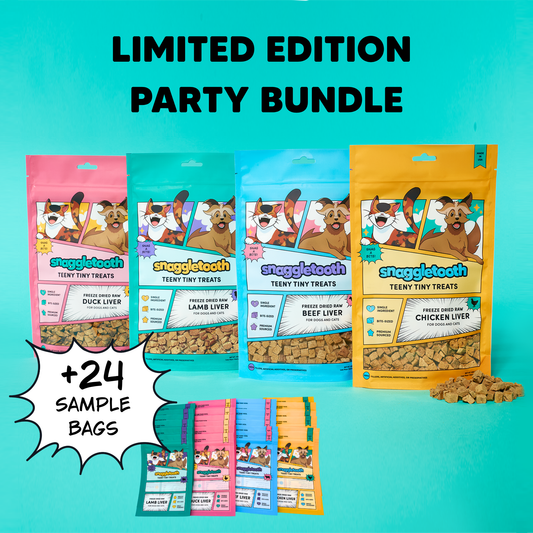
Snaggletooth’s Beef Liver, Chicken Liver, Duck Liver, and Lamb Liver treats each have a one-word ingredient list — beef liver, chicken liver, duck liver, lamb liver. Every batch is tested by independent laboratories before it ships. Not because they have to brag about it. Because it’s the standard they hold themselves to.
Human Grade vs. Feed Grade: Why It Actually Matters
You’ve probably seen “human grade” on a pet food label and wondered if it’s just marketing speak. It’s not — but it’s also a term that’s been misused enough that it’s worth understanding what it actually requires.
According to AAFCO’s 2023 guidelines, to legitimately label a product “human grade,” every single ingredient in it must meet human food standards — and it must be manufactured in a facility registered as both an FDA animal food facility and an FDA human food facility. That means USDA inspections, not just pet food facility checks.
Feed-grade products operate under a different set of rules. They’re permitted to include ingredients that would not pass human food inspection — including what’s known as “4D meat” (sourced from dead, dying, diseased, or downer animals). Most pet treats on store shelves are feed grade. Most pet owners don’t know that.
Human-grade treats cost a little more to make. That cost is real, and it’s passed on to you. But when you understand what “human grade” actually means — not just as a marketing phrase but as a production standard — it’s easier to understand why the price difference exists.
Your Quick-Reference Label Checklist
Next time you pick up a bag of treats, run through this:
- What’s the first ingredient? It should be a named protein (beef, chicken, duck, lamb — not “meat” or “poultry”).
- How many ingredients are there total? More ingredients = more complexity = more places for problems to hide.
- Do you see the same base ingredient listed multiple times under different names? That’s splitting.
- Is there any mention of “by-product meal,” artificial preservatives, or colors? Red flag.
- Does the label say “human grade” — and does the company explain what that means for their product? If they can’t explain it, it might not mean much.
The Smallest Treats, The Shortest Ingredient List
If you want to make the label-reading game easy on yourself, Snaggletooth’s Teeny Tiny Treats Bundle gives you all four flavors to try — beef, chicken, duck, and lamb — with an ingredient list you can read in a single breath. Each one clocks in at under 1 calorie per treat, which means you can reward your pet dozens of times during a training session without worrying about the math.
Sometimes the best way to know what to look for is to experience what a clean label actually looks like. It turns out it can fit in one word.
Sources: AAFCO — Reading Labels · AKC — How to Read a Dog Food Label · FDA — Pet Food