If your dog blows off a biscuit during training but loses their entire mind for a piece of chicken off your plate, you haven’t failed as a trainer. You’ve just run into one of the most useful (and most underrated) concepts in dog behavior: the treat hierarchy.
Every dog has one. It’s the mental ranking of every food reward on earth, from “meh, fine” all the way up to “I will do literally anything for this.” Once you understand where your current training treat falls on that ladder, a lot of “stubborn” behavior suddenly starts to make sense.
Let’s break it down — and talk about what high value treats for dog training actually means.
Why your dog ignores some treats
Dogs aren’t refusing to work because they’re bad students. They’re making a tiny cost-benefit calculation in real time. Is the reward worth the effort of leaving that smell, that squirrel, that spot on the couch? If the answer is no, they tune you out.
The American Kennel Club puts it simply: training works when the treat out-ranks the distraction. In a quiet kitchen, a plain biscuit is probably fine. On a trail surrounded by bunnies and smells, that biscuit isn’t going to cut it. You have to level up.
That’s what trainers mean when they talk about “high value” — a treat so irresistible that, for two seconds, your dog forgets everything else exists.
The treat hierarchy, ranked
There’s no official chart, but most professional trainers agree on roughly five tiers.
Tier 1: Kibble
Your dog’s regular food. Useful for very easy cues in calm environments, and a great way to stretch a training budget. Not reliable for anything your dog actually finds hard.
Tier 2: Standard commercial biscuits
Crunchy biscuit-style treats. Familiar, tasty enough, rarely thrilling. These sit firmly in the “okay reward for sitting in the living room” tier.
Tier 3: Soft and semi-moist training treats
Soft chews, jerky pieces, the classic Zuke’s-style treat. More motivating than biscuits, but often heavy on calories (2–4 kcal each is normal) and padded with ingredients beyond the named protein. Fine for short sessions, but the calorie math climbs fast.
Tier 4: Freeze-dried single-ingredient meat
This is where the best training treats live. Freeze-dried liver in particular is basically concentrated meat smell — and dogs are built to respond to that. Because freeze-drying removes water without heat processing, you get roughly half a pound of fresh meat compressed into a 2 oz bag.
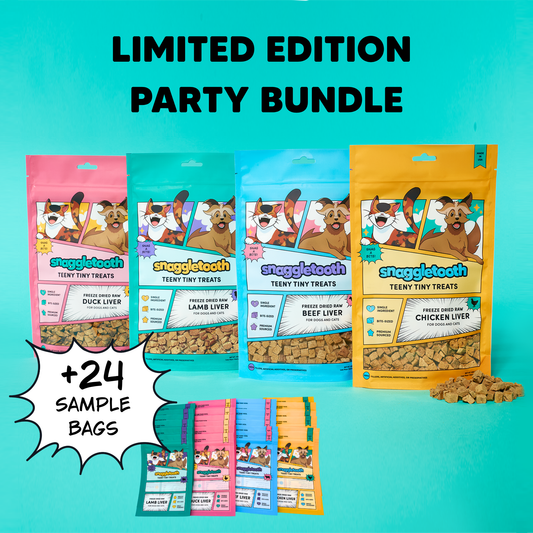
Snaggletooth’s Beef Liver, Chicken Liver, Duck Liver, and Lamb Liver Teeny Tiny Treats all live in this tier — one ingredient, pre-sized to a 3/8th″ cube, around 1 calorie or less each.
Tier 5: Fresh cooked meat, cheese, hot dogs
The “I will respond from anywhere on earth” tier. A small square of cheese, a bit of cooked chicken breast, a pea-sized piece of hot dog. These work — but they also come with mess, crumbs, calorie spikes, and often a lot of sodium you don’t really want in a treat pouch for an hour-long session.
For most owners, freeze-dried liver is the sweet spot. It behaves like Tier 5 in a dog’s brain, but it stores in a pocket, doesn’t need refrigeration, and doesn’t leave grease on your fingers.
Recall: the command that demands high value
Most obedience behaviors are fairly forgiving. Sit, down, stay — a medium-value reward is usually enough to get the job done.
Recall is different. Asking your dog to abandon whatever incredible thing they’re currently doing and run back to you is one of the hardest behaviors you will ever train. The American Veterinary Medical Association emphasizes that positive reinforcement only works when the reinforcer is actually reinforcing — meaning the dog genuinely wants it in the moment. At the dog park, chasing a squirrel is a 10/10. A kibble nugget is a 2/10. You’re not going to win that math.
This is why trainers are so firm about saving your highest-value reward for recall specifically. Don’t burn your best treat on a lazy “sit” in the kitchen. Reserve it for the moments that are genuinely hard — and for emergencies, when calling your dog off something could keep them safe.
The calorie math no one talks about
Here’s the other half of the high-value conversation that most articles skip: you can’t reward 30 times in a training session with a 3-calorie treat. You just can’t. By treat ten, a 10-pound dog has already blown through their daily treat budget.
This is where size and density matter almost as much as flavor.
A freeze-dried treat at roughly 1 calorie per piece means you can run 10, 20, even 30 reps in a single session and still stay safely inside the 10% rule most veterinarians recommend for treats and snacks. That’s the difference between a productive training session and accidentally feeding a second meal.
For comparison:
- Snaggletooth Chicken Liver: 0.93 kcal per treat
- A common soft training treat: ~3 kcal per treat
- A small Milk-Bone biscuit: ~20 kcal per treat
If you’re trying to build a behavior that needs lots of repetitions — recall, loose-leash walking, place training, duration work — your calorie budget disappears shockingly fast with anything from Tier 2 or Tier 3.
How to use the hierarchy in real life
A practical system most trainers recommend:
- Easy behaviors, quiet spaces: kibble or Tier 2
- New skills, moderate distractions: Tier 3 or Tier 4
- High-distraction environments (parks, walks, new places): Tier 4
- Recall and emergency cues: Tier 4 or a reserved Tier 5
The mistake most owners make is giving the good stuff for everything. When your highest-value treat is always available, it stops being special. Keep freeze-dried liver for the hard asks, and your dog will work noticeably harder to earn it.
One more tip from the trainer playbook: vary your flavors. Novelty is part of what makes a reward feel “high value” to begin with — so rotating between beef, chicken, duck, and lamb can keep motivation high across long training stretches (just as long as your dog's tummy can handle it!)
A tiny treat for a big payoff
If you’ve been wondering why your dog seems disinterested during training, it’s almost never a training problem. It’s a currency problem. Upgrade the reward, and most “stubborn” dogs become willing partners surprisingly fast.
The Teeny Tiny Treats Bundle gives you all four proteins — beef, chicken, duck, and lamb — so you can figure out which flavor your dog finds most motivating. Most pets have a clear preference, and once you find theirs, you’ve basically unlocked a cheat code for training.
Train smarter. Reward bigger. And remember: it’s the ranking, not the bag, that matters to your dog (or your cat!)