If you've ever trained a dog — really trained one, with repetition after repetition until "sit" actually sticks — you know the drill. Reach into the pouch. Reward. Repeat. A five-minute session can easily burn through 30, 40, even 50+ treats. And that's just one session.
Now here's the question most pet parents don't think to ask: how many calories did my dog just eat in training alone?
The answer, for most low calorie training treats for dogs, might surprise you.
The 10% Rule (and Why Training Breaks It So Easily)
Veterinarians and organizations like the World Small Animal Veterinary Association (WSAVA) agree on a simple guideline: treats should make up no more than 10% of your dog's daily calories. The other 90% should come from complete, balanced meals.
Sounds reasonable. But let's do some math.
A 5-pound Chihuahua needs roughly 150 calories per day. Ten percent of that? Just 15 calories for treats — total, for the entire day.
A 10-pound Yorkie? Maybe 250 daily calories. That's a 25-calorie treat budget.
Now look at what's in your treat pouch.
The Hidden Calorie Problem
Most popular training treats on the market clock in around 3 to 5 calories per piece. Some "low calorie" options still hover at 2 to 3 calories each. That doesn't sound like much — until you start multiplying.
Let's say you're working on recall with your pup and you go through 50 treats in a session (totally normal for active training). Here's what that looks like:
- At 3 calories per treat: 50 treats = 150 calories
- At 5 calories per treat: 50 treats = 250 calories
For that 5-pound Chihuahua with a 15-calorie treat budget? You've blown past it by ten times with the 3-calorie option. For the Yorkie, the 5-calorie treat just consumed their entire day's worth of food — in one training session.
This is how well-meaning pet parents accidentally overfeed their dogs. Not at mealtime. At training time.
Why Small Dogs Get Hit the Hardest
Larger dogs have more caloric wiggle room. A 50-pound Lab eating 1,000 calories a day can absorb a 150-calorie training session without too much trouble.
But small breeds — the Pomeranians, the toy poodles, the Chihuahuas, the terriers — are working with razor-thin margins. Their daily calorie needs are so low that even a moderate training session with standard treats can throw their whole diet off balance. And that's before you factor in the treats they're getting just for being adorable throughout the rest of the day.
This is exactly why the AKC recommends choosing treats that are small and can be eaten quickly, so your dog gets lots of rapid rewards without the caloric baggage.
The Fix: Treats That Let You Train More, Not Less
The solution isn't to train less or reward less often. Frequent reinforcement is how dogs learn — cutting back on rewards just slows everything down. The fix is finding treats where the math actually works.
That means looking for treats that are:
- Under 1 calorie each — so even 30+ treats registers on the daily budget
- Genuinely small — not "break them in half" small, but actually bite-sized out of the bag
- High-value enough to hold attention — because a low-calorie treat your dog ignores isn't saving you anything
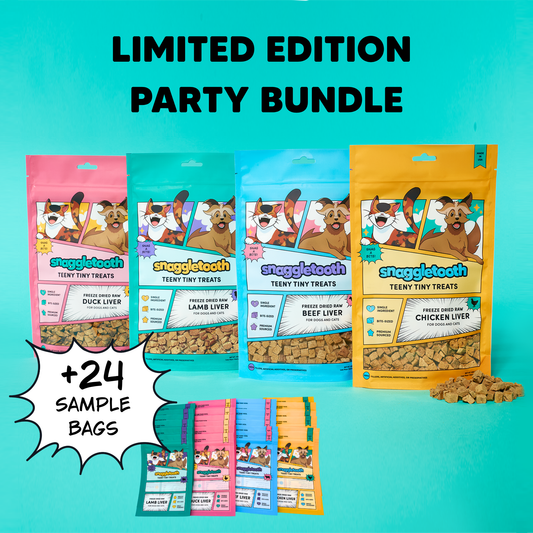
This is exactly why we made Teeny Tiny Treats the way we did. Each treat is a 3/8th-inch cube, under 1 calorie (our Beef Liver treats clock in at 0.80 kcal each), and they're 100% single-ingredient freeze-dried liver. No fillers padding the calorie count. No binders. Just protein.
Let's redo that math: 30 treats at 0.80 calories = 24 calories. For the 5 pound Chihuahua with 150 daily calories, that's a more reasonable training range but still on the higher end. For the 10 pound Yorkie with 250 calories, it's right at the 10% daily caloric value.
A Smarter Way to Think About Training Treats
Here's a quick framework for choosing the best training treats for small dogs:
Check the calorie count per treat, not per bag. Packaging loves to highlight the total bag calories or serving size. What matters for training is the per-piece number — because you're giving one at a time, dozens of times.
Match treat size to your dog's mouth. If you're breaking treats in half before every session, they're too big. Your dog should be able to eat and refocus in under two seconds. That speed is what keeps the reinforcement loop tight.
Prioritize real ingredients over marketing terms. "Natural" and "wholesome" don't mean much legally. Look for treats where you can count the ingredients on one hand — or better yet, one finger. Single-ingredient treats give you full transparency: you know exactly what your dog is eating and exactly how many calories they're getting.
Factor in the whole day. Training sessions aren't the only time your dog gets treats. Walks, vet visits, enrichment toys, the "please stop barking at the mailman" treat — it all adds up. The lower your per-treat calorie count, the more flexibility you have across the entire day.
The Bottom Line
Training is one of the best things you can do for your dog. It builds confidence, strengthens your bond, and keeps their brain sharp. The last thing you want is for the treats that make training work to quietly undermine their health.
So next time you reach for the treat pouch, take two seconds to do the math. Your dog — and their waistline — will thank you.
Want to try treats where the math just works? Our Teeny Tiny Treats come in four single-ingredient flavors (beef, chicken, duck, and lamb), each under 1 calorie per treat. Over 250 treats per bag — that's a lot of "good boys" and "good girls."